
POSTCARD FROM NORTH CAROLINA - AUGUST 2026
On the Liberation of Accepting Limits
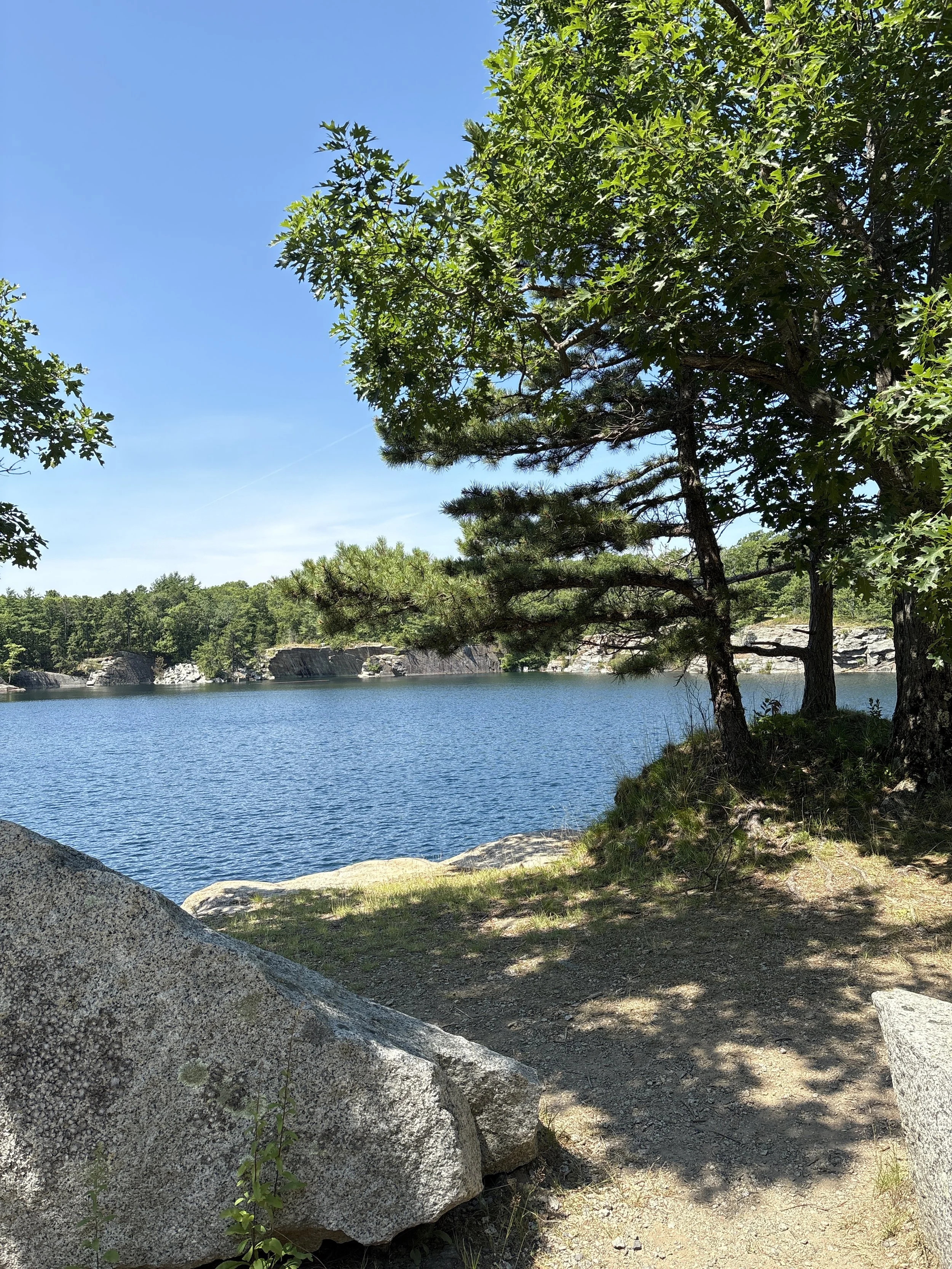
Four weeks ago, I was swimming in a Massachusetts quarry with my cousin Nancy. The water was fresh and clear. The day was gorgeous. It was exactly how I wanted to begin my break from the North Carolina heat.
Nancy and I share a family history. We are both descendants of William Weiss, carrying forward whatever our ancestors gave us—the beautiful, the painful, and the unfinished.
Our conversation that day began with death.
We talked about the heartbreaking decisions families face when someone they love is nearing the end of life. When do we stop trying to extend life at all costs?
When does another procedure, another intervention, another attempt to fight the inevitable become less about caring for someone and more about our own inability to accept what is happening?
We talked about hospice. And I found myself thinking about the wisdom of hospice.
There is a time when love stops trying to conquer reality and starts accompanying reality.
That conversation stayed with me because I have spent much of my life suspicious of limits.
Given my history, this makes sense. Given my commitment to collective liberation, limits—or “the rules”—have often been used as tools of domination. Who is allowed freedom? Who is restricted? Whose body is controlled? Whose choices are questioned?
As someone committed to liberation, I have sometimes confused restraint with oppression. I have worried that creating boundaries for myself was somehow participating in the very systems I work against.
But swimming in that quarry, I began wondering:
What if not all limits are oppression?
What if some limits are relational?
What if “enough” could become a drumbeat for health and freedom?
I have been thinking about this question in my racial justice work, too.
Years ago, I worked with a large, progressive, LGBTQ-inclusive church in the American South. The church was committed to being welcoming. Most members identified as LGBTQ. The congregation was racially diverse. They had a Spanish-language service. In many ways, it was the kind of church many people long for.
The leader of the church board approached me at a conference and asked for help facilitating a conversation about racial justice.
She was sincere. She cared. She wanted to do the right thing.
And she was also at the beginning of understanding what racial justice work actually asks of white people.
As we talked, I noticed that her understanding of racial justice was still rooted in a familiar framework: white people helping people of color become more included in the beautiful community that already existed.
The work was about helping them enter.
The work was not yet about questioning who had designed the room.
This is one of the places where internalized white dominance shows up.
Not only through hatred. Not only through exclusion.
Sometimes, because we care, we believe we should be the ones leading.
During this process, young people of color in the church were criticized for how they dressed and behaved on Sundays. The white leadership handled the situation poorly, and harm was caused.
The young people responded by offering a list of requests for repair:
A public apology from the leader and the board.
An acknowledgment of stolen lands.
A sermon series about racism.
A survey of the congregation about experiences of racism.
A survey of former members about their experiences.
I remember thinking: What a gift!
How often do white people say, “Just tell us what we need to do”?
Here was a community saying exactly what they needed. There was a roadmap.
But then something unexpected happened.
The same white leader who had asked for support in centering racial justice became upset that the process was no longer unfolding according to her vision.
She felt that the work had been hijacked.
The people most impacted by racism had stepped forward with their own understanding of what repair required, and somehow that felt offensive to her. It did not fit her plan.
This was the moment when love of a community had to be separated from control over a community.
This is the difficult work of dismantling internalized dominance.
It is not only about identifying the people who are doing harm.
It is about noticing the places where we as white people cannot tolerate not being the expert.
Where we believe our intentions should outweigh someone else’s experience.
Where we want liberation—as long as we get to decide what liberation looks like.
And then I found myself asking:
How often have I been this white woman?
Not necessarily in this exact situation. But in the deeper pattern.
How often have I resisted reality because reality felt like someone taking something away from me?
That question has been showing up in my own life.
With my body.
With my health.
With my relationship to money.
For a long time, I have carried a belief that limits are a form of punishment. That telling myself no is somehow an act of domination. That accepting boundaries means I am becoming part of the systems I have spent my life challenging.
But perhaps the problem is not limits themselves.
Perhaps the question is: Who—or what—is creating the limit, and what is the limit making possible?
The quarry offered me another possibility.
The water has limits.
The earth has limits.
The body has limits.
A river is not oppressed because it has banks.
A tree is not failing because it cannot grow forever.
A dying person is not failing because their body has reached the end of what it can do.
Hospice does not mean giving up on life.
It means honoring the life that is actually here.
Maybe that is the practice I am learning.
Not control.
Not surrender.
Relationship.
A loving relationship with reality.
Because there is a difference between a cage and a container.
A cage says:
You are too much.
You need to be controlled.
A container says:
You belong here.
You are worthy of care.
Maybe liberation is not the absence of limits.
Maybe liberation is learning which limits come from domination and which limits come from love.
Enough food.
Enough money.
Enough rest.
Enough certainty.
Enough control.
Enoughness is not a failure of imagination.
It may be one of the most radical acts of resistance available to us.
To stop extracting from ourselves.
To stop demanding endless growth from our bodies, our communities, and our planet.
To accept that we belong to something larger.
The quarry taught me something that day:
The edges are not what keep us from freedom.
Sometimes the edges are what allow us to float.

Who made the world?
Who made the swan, and the black bear?
Who made the grasshopper?
This grasshopper, I mean—
the one who has flung herself out of the grass,
the one who is eating sugar out of my hand,
who is moving her jaws back and forth instead of up and down—
who is gazing around with her enormous and complicated eyes.
Now she lifts her pale forearms and thoroughly washes her face.
Now she snaps her wings open, and floats away.
I don’t know exactly what a prayer is.
I do know how to pay attention, how to fall down
into the grass, how to kneel down in the grass,
how to be idle and blessed, how to stroll through the fields,
which is what I have been doing all day.
Tell me, what else should I have done?
Doesn’t everything die at last, and too soon?
Tell me, what is it you plan to do
with your one wild and precious life?
“The Summer Day” by Mary Oliver reprinted by the permission of The Charlotte Sheedy Literary Agency as agent for the author. Copyright © 1990, 2006, 2008, 2017 by Mary Oliver with permission of Bill Reichblum
Provocations and Nourishment
Becoming Human with one another
with Rev. Roberto Che Espinoza, PhD - check out his substack!
Upcoming Opportunities
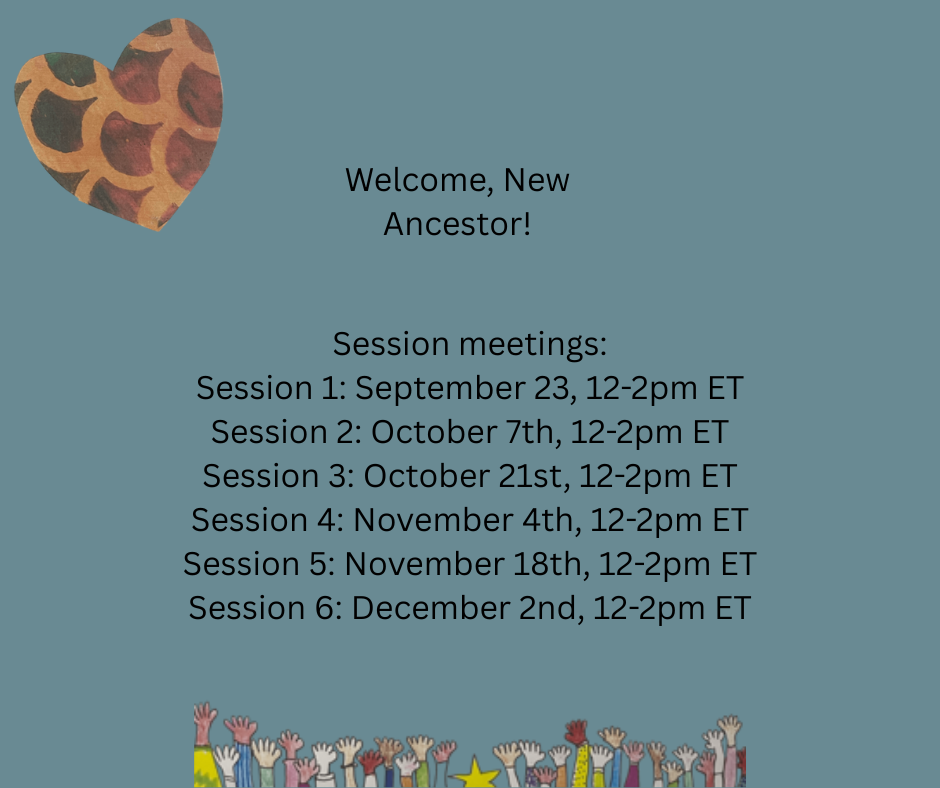
New ancestors rides again!
White people with rank or influence! Here’s a space to show up for your own journey. Fall antiracism coaching group.
how to end things, at lighthouse writers workshop this august, mondays, taught by leila nadir, starting on the 17th. We will study all things endings, including how endings are a kind of philosophy of life, a way of seeing the world.
Toward Justice,
Evangeline
Please share this blog with any of your friends working to build more just communities and organizations.
To receive this monthly Postcard from North Carolina directly in your inbox, please sign up below!